Today, Attorney Dillon Harris secured a unanimous monumental decision by the Maryland Supreme Court, following oral argument last November. The Supreme Court’s Opinion reverses the decision of the Maryland Appellate Court In the Matter of Mark McCloy where the Appellate Court held that Mr. McCloy had been convicted of an out-of-State offense that would be classified as a violation in Maryland punishable by more than two years of imprisonment, a “disqualifying crime,” and that the determination of what constituted such an offense was subject to a two-step “substantial evidence” test that we argued was functionally deferential to the Maryland State Police (MSP).
For a quick explanation of the background, Mr. McCloy was convicted of a federal criminal offense that did not trigger a federal firearms disability in 1999. In 2015, he sought an HQL and was denied. He appealed, but prior any hearing on the appeal, MSP issued the HQL. In 2021, Mr. McCloy was denied the purchase of a regulated firearm, having already purchase several in the intervening years, on the basis that his federal conviction was equivalent to a Maryland disqualifying offense. We represented Mr. McCloy throughout the appeals process before the Office of Administrative Hearings, the Circuit Court, the Appellate Court, and finally, the Maryland Supreme Court. At each level of appeal prior to the Supreme Court, the denial was upheld, but for a different rationale every time.
The Court’s Opinion begins with a detailed explanation of the relevant statutory provisions and the procedural background in this case, explaining that
An out-of-State conviction is disqualifying if the conviction is for a crime that is equivalent to a Maryland disqualifying crime under PS § 5-101(g). The issue in this case is how to determine whether an out-of-State crime is equivalent to a Maryland disqualifying crime.
On which version of a relevant MD statute is applicable, the Court held
[I]f you want to buy a handgun today, what matters is the General Assembly’s assessment today of which crimes are disqualifying. So, for comparison purposes, we look to Maryland law at the time the firearm application was filed, not at the time of the [out-of-State] conviction.
In turning to how to decide whether two offenses are equivalent, the Court formulates a two-prong test
[A]n out-of-State offense would be equivalent to a Maryland disqualifying crime if the elements of the former are the same as or narrower than any crime that is “disqualifying” under PS § 5-101(g). If this categorical analysis demonstrates that the out- of-State statute is equivalent to a Maryland disqualifying crime, then the out-of-State crime is also disqualifying, and the analysis ends there.
But if the elements of the out-of-State crime are broader than the Maryland crime, then the analysis is not over because, depending on the information available to the MSP, the MSP may yet determine that the applicant was convicted of an offense that satisfies all the elements of a disqualifying Maryland crime under PS § 5-101(g).
Under this test, the question is one of both law and fact. If the MSP, or a reviewing court, determines that the elements of the out-of-State crime are more broad than the Maryland crime, then they turn to whether there is “conclusive evidence” to show that the applicant was convicted of having committed acts that establish all the elements of the in-state offense. In the absence of “conclusive evidence” showing that a conviction of the Maryland crime could be supported, the offenses are not equivalent.
Here, the Court found the out-of-State offense to be more broad than the local offense, and includes in its opinion an illustrative table prepared by Attorney Harris and included in our briefing to make exactly that point. When turning to the facts, the Court held that the even accepting as true all of the available information, there is insufficient evidence to show that he could have been convicted of the Maryland offense.
In a bit of an unusual turn, rather than explaining it’s reasoning throughout the opinion at each step, the Court spends pages 25-28 of the opinion explaining why it discarded the two-step test formulated by the Appellate Court. That test would have assessed whether the offenses prohibit “similar” conduct, and if so, whether a “reasonable mind” could conclude the conduct could be prohibited by the Maryland equivalent statute.
The Court explains, and uses venn diagrams to illustrate,
Our concern with the Appellate Court’s two-part test stems from its inherently subjective nature. First, there is no standard for determining whether the two statutes prohibit “similar” conduct.
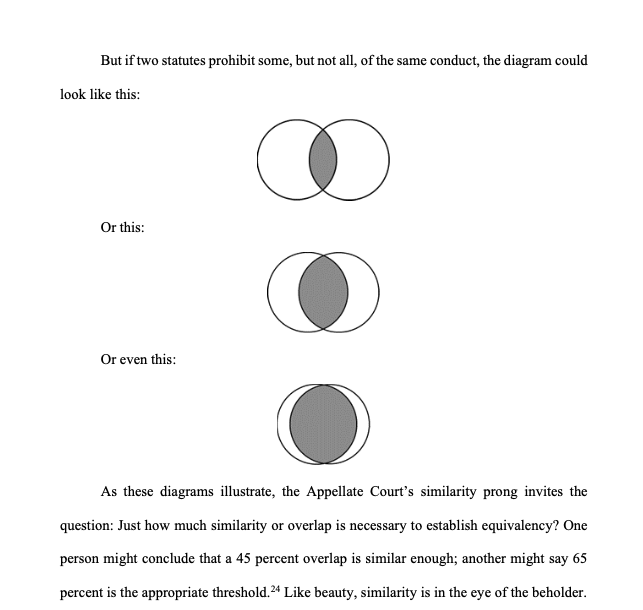
On the second prong, the Court stated
[I]t appears that the Appellate Court’s test would invite the MSP to consider and determine disputed facts underlying the out-of-State conviction…
The second step of the Appellate Court’s test, as we understand it, allows for the MSP to act as a factfinder to resolve conflicting evidence [ ]. Thus, two reasonable minds weighing the same evidence could reach different conclusions, both of which could be affirmed on judicial review under the substantial evidence test. We see no basis in the text of the statute to conclude that the General Assembly intended to assign the MSP such a factfinding task.
To summarize the new test and its conclusion, the Court explains
To determine whether a conviction under an out-of-State law constitutes a conviction for a disqualifying crime, the MSP should first determine whether the elements of the out-of-State crime of which the applicant was convicted are the same as or narrower than any Maryland crime that is disqualifying under PS § 5-101(g). If the answer to that question is yes, then the applicant’s out-of-State conviction is likewise disqualifying. If the answer to that question is no, and if the MSP has a sufficient basis to conclusively determine the acts of which the applicant was convicted, then the MSP should determine whether such acts would support a conviction under a disqualifying Maryland crime. Applying that test here, we hold that based on the information available to the ALJ, Mr. McCloy was not convicted of a disqualifying crime.
If you or someone you know has been denied your HQL, HGP, or any firearm purchases/transfers in Maryland as a result of an out-of-state equivalent conviction, or for any other reason, contact FICG today to discuss your options.
Firearms Industry Consulting Group® (FICG®) is a registered trademark and division of Civil Rights Defense Firm, P.C., with rights and permissions granted to Prince Law Offices, P.C. to use in this article.

 Prince Law Offices Blog
Excellent result based on first-class legal work!
LikeLiked by 1 person